
Get in Touch
- Career Support
+91 789 8657 881
- Business Support
+91 789 8117 784
- Email Now
info@cloudwapp.com
Onam Plaza, 210 - 214, AB Rd, Near Industry House, Old Palasia, Indore, Madhya Pradesh 452001
Loading…
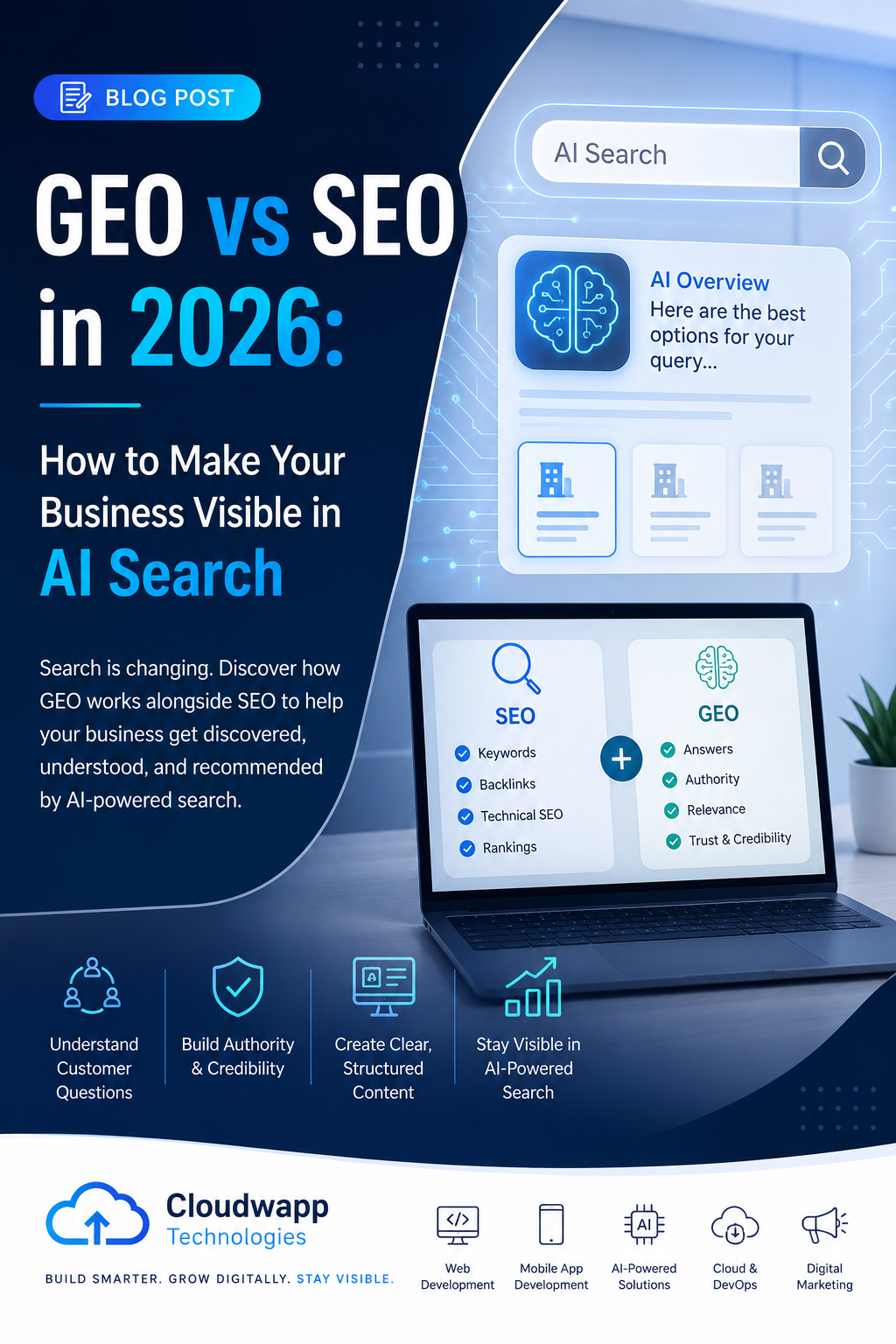
GEO vs SEO in 2026: How to Make Your Business Visible in AI Search Search is changing. For years, businesses focused on ranking their websites on Google using traditional Search Engine Optimisation (SEO). Keywords, backlinks, technical performance, content quality, and search rankings were the core of digital visibility. But in 2026, people are increasingly asking AI-powered search systems to research topics, compare options, explain products, and recommend businesses. Google has expanded AI-powered experiences such as AI Overviews and AI Mode, allowing users to ask longer and more complex questions and continue conversations directly within Search. This has created a new opportunity for businesses: Generative Engine Optimisation (GEO). What Is GEO? Generative Engine Optimisation, commonly called GEO , is the practice of improving a brand's online presence so that its content can be discovered, understood, referenced, or recommended by AI-powered search and answer systems. Instead of focusing only on: How can my website rank on Google? businesses now also need to consider: How can my brand become a trusted source when AI answers a customer's question? AI-powered search experiences can summarize information from multiple sources and provide links that allow users to explore further. This means visibility is no longer limited to traditional blue search results. SEO vs GEO: What's the Difference? SEO and GEO are closely connected, but they focus on different search experiences. Traditional SEO SEO focuses on improving a website's visibility in conventional search results. Important areas include: - Keyword optimisation - Technical SEO - Website speed - Mobile responsiveness - Internal linking - Backlinks - Search intent - High-quality content - Website authority GEO GEO focuses on making information useful and understandable for AI-powered search and answer systems. Important areas include: - Clear and authoritative content - Well-structured information - Strong topical relevance - Accurate business information - First-hand expertise - Consistent brand information - Useful answers to real questions - Trust and credibility - Content that can be easily interpreted and referenced The important point is that GEO does not replace SEO. Instead, businesses should think of GEO as an additional layer of their digital visibility strategy. Why GEO Matters in 2026 Search behaviour is becoming more conversational. Instead of searching: best software company Indore a potential customer might ask: Which software development companies in Indore can build a custom CRM for a growing business? AI-powered search is designed to understand longer, more detailed questions and provide synthesised answers. Google says AI Mode is built to handle complex queries, follow-up questions, multimodal inputs, and deeper exploration of the web. This creates a new challenge for businesses. Having a website is no longer enough. Businesses need to create useful, trustworthy, structured, and genuinely informative digital content. 7 Ways Businesses Can Improve GEO 1. Create Content That Answers Real Questions One of the easiest ways to prepare for AI search is to stop writing content only around keywords. Instead, identify the questions your customers actually ask. For example, a software development company could create content around: How much does custom software development cost? - Should a business build or buy CRM software? - How can AI automate customer support? - What is the difference between a web app and a mobile app? - How can businesses migrate applications to the cloud? - What should companies consider before developing an AI application? Answer these questions clearly and comprehensively. The objective should be to help the reader, rather than simply insert keywords into an article. 2. Build Topic Authority Publishing one article about a topic is rarely enough to establish strong expertise. Instead, businesses should build a collection of related content. For example, a company offering AI development could publish: - What Is Generative AI? - AI Agents Explained - AI Automation for Businesses - AI Chatbots vs AI Agents - How Businesses Can Implement AI - AI Security Best Practices - Cost of Developing an AI Application - AI Trends for Businesses Together, these articles create a stronger topical presence. 3. Make Your Website Easy to Understand AI systems need to understand what your business does. Your website should clearly communicate: Who you are → What you offer → Who you serve → What problems you solve → Why customers should trust you. Important website elements include: - Clear service pages - About Us page - Contact information - Company details - Industry-specific pages - Case studies - FAQs - Author information - Customer reviews - Portfolio/projects - Consistent business information A well-organised website benefits both traditional search engines and AI-powered discovery. 4. Use Clear Content Structure AI systems and human readers both benefit from well-organized content. Instead of writing large blocks of text, use: - Descriptive headings - Short paragraphs - Bullet points - Tables where useful - FAQs - Step-by-step explanations - Definitions - Examples - Key takeaways For example: What Is Custom Software Development? Give a direct definition. What Are Its Benefits? List the major benefits. Who Needs Custom Software? Explain the ideal use cases. How Much Does It Cost? Explain the factors affecting pricing. This structure makes information easier to understand and navigate. 5. Demonstrate Real Expertise AI search is not simply about producing more content. Businesses should demonstrate that they actually understand their subject. Instead of publishing generic statements such as: AI is transforming the world. Provide useful information: - Real implementation considerations - Industry examples - Practical recommendations - Technical explanations - Original insights - Lessons from projects - Common mistakes - Expert opinions Original experience can make business content much more valuable. 6. Strengthen Your Brand's Online Presence Your website is only one part of your digital identity. Businesses should maintain consistent information across relevant platforms, including: - Company website - LinkedIn - Business directories - Industry websites - Review platforms - Social media - Press mentions - Partner websites The goal is to create a consistent digital identity around your company. If your business name, services, descriptions, and contact information are inconsistent across platforms, it can make your online presence less clear. 7. Don't Forget Traditional SEO GEO does not mean abandoning SEO. Technical website quality still matters. Businesses should continue working on: - Page speed - Mobile optimization - Search-friendly URLs - Metadata - Internal links - Structured content - Crawlability - Website security - Quality backlinks - Helpful content - Search intent A strong GEO strategy should be built on top of a strong SEO foundation. GEO, SEO and AEO: How Are They Connected? You may also hear another term: AEO — Answer Engine Optimisation. These three concepts can be viewed as different parts of modern search optimization. SEO optimises content and websites for traditional search engines. AEO focuses on providing direct answers to user questions. GEO focuses on visibility within generative AI and AI-powered search experiences. There is significant overlap between all three. The common goal is: Create useful information that search systems can understand and users can trust. What Businesses Should Do Now Companies don't need to completely redesign their marketing strategy overnight. Start with a simple process. Step 1: Audit Your Website Check whether visitors can immediately understand what your company does and what services you provide. Step 2: Identify Customer Questions Talk to your sales and support teams and collect frequently asked questions. Step 3: Create Helpful Content Turn those questions into detailed guides, articles, FAQs, and service content. Step 4: Improve Existing Pages Update outdated service pages and make them clearer, more useful, and more specific. Step 5: Build Authority Publish original insights, case studies, project experiences, and industry knowledge. Step 6: Monitor AI Search Visibility Search for your business and services through AI-powered search experiences and observe how your brand appears—or whether it appears at all. Step 7: Keep Improving AI search is still evolving rapidly, so GEO should be treated as an ongoing strategy rather than a one-time optimisation project. The Future of Search Is Becoming More Conversational The biggest change is not simply that AI is appearing in search results. It is that the way people search is changing. People can now ask more detailed questions, provide context, ask follow-up questions, and explore information conversationally. Google describes AI Mode as an experience designed for deeper research and follow-up exploration, with links connecting users to web content. For businesses, this means digital marketing needs to evolve from: Rank for this keyword. Become the best source for this customer's question. That is the mindset behind GEO. Final Thoughts SEO is not disappearing. Instead, search is expanding. Traditional search results, AI-generated answers, conversational search, voice queries, visual search, and other discovery methods are becoming part of the modern digital ecosystem. Businesses that invest in high-quality content, strong technical foundations, clear brand information, genuine expertise, and useful customer-focused resources will be better positioned for this transition. The future of search is not just about being found. It is about being understood, trusted, and recommended. Ready for the Next Generation of Digital Visibility? At Cloudwapp Technologies we help businesses build modern digital solutions, including websites, custom software, AI-powered applications, mobile apps, cloud solutions, DevOps, and digital marketing solutions. As search continues to evolve, businesses need digital experiences that are not only designed for today's users but prepared for tomorrow's technology. Build smarter. Grow digitally. Stay visible.