
Get in Touch
- Career Support
+91 789 8657 881
- Business Support
+91 789 8117 784
- Email Now
info@cloudwapp.com
Onam Plaza, 210 - 214, AB Rd, Near Industry House, Old Palasia, Indore, Madhya Pradesh 452001
Loading…
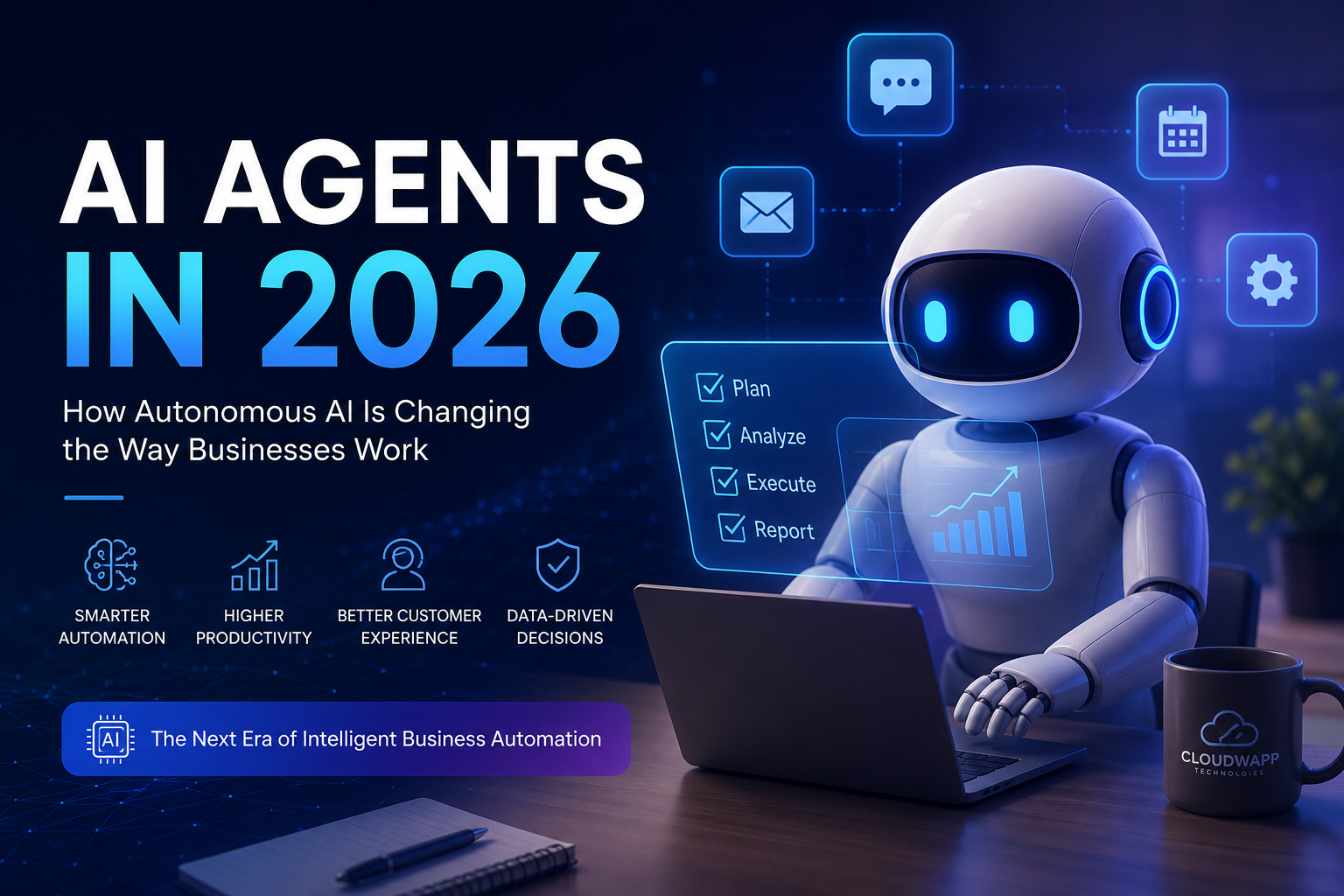
AI Agents in 2026: How Autonomous AI Is Changing the Way Businesses Work AI is no longer just answering questions. In 2026, it is increasingly capable of taking action. Over the past few years, businesses have rapidly adopted artificial intelligence for content creation, customer support, analytics, software development, marketing, and automation. But the next stage of AI is moving beyond simple prompts and chatbots. The rise of AI agents is changing how businesses think about automation. Unlike traditional software that follows a fixed sequence of instructions, AI agents can understand a goal, break it into multiple tasks, use connected tools, and take actions with varying levels of human supervision. For businesses, this could mean faster operations, smarter decision-making, and more personalized customer experiences. What Are AI Agents? An AI agent is an intelligent software system designed to perform tasks on behalf of a user or organization. For example, instead of simply asking an AI chatbot to write a customer response, an AI agent could potentially: * Read a customer request * Understand the problem * Check relevant information * Prepare a response * Update a CRM * Create a support ticket * Notify the appropriate team * Follow up with the customer This shift—from generating information to completing workflows is one of the most important developments in business technology today. Why AI Agents Are Trending in 2026 Businesses are under constant pressure to improve productivity while controlling costs and delivering better customer experiences. AI agents offer a way to automate repetitive and multi-step processes without requiring every task to be manually handled by employees. Current industry discussions around AI increasingly focus on moving from experimentation to practical business implementation. Organizations are exploring agentic workflows for areas such as customer service, software development, security, data analysis, and internal operations. The goal is not simply to “use AI.” The goal is to build smarter business processes around AI. 5 Ways AI Agents Can Transform Businesses 1. Smarter Customer Support AI agents can help businesses manage customer interactions around the clock. They can understand customer queries, retrieve relevant information, classify requests, and route complex issues to human employees. This can reduce response times while allowing support teams to focus on problems that require human judgment. 2. Automated Business Workflows Many businesses still depend on repetitive manual processes. Examples include: * Data entry * Report generation * Lead qualification * Appointment scheduling * Invoice processing * Internal notifications * Document processing AI agents can connect different systems and automate parts of these workflows, reducing unnecessary manual effort. 3. AI-Powered Software Development AI is also changing how software teams build and maintain applications. Development teams can use AI-assisted systems for code generation, testing, debugging, documentation, and code analysis. The biggest opportunity is not replacing developers. It is allowing developers to spend more time on architecture, product decisions, security, and complex problem-solving. 4. Personalised Business Experiences Customers increasingly expect businesses to understand their needs. AI agents can analyse customer interactions and business data to help deliver more personalised recommendations, communication, and services. For example, an e-commerce platform could use intelligent systems to understand customer preferences and recommend products based on previous interactions. 5. Faster Business Decision-Making Modern businesses generate huge amounts of data every day. AI agents can help collect information from different sources, identify patterns, summarise important findings, and present insights to decision-makers. This can help management spend less time searching for information and more time acting on it. AI Agents vs Traditional Automation Traditional automation generally works according to predefined rules. For example: If a customer submits Form A → Send Email B. AI-powered automation can be more flexible. It can interpret the customer's request, determine what information is required, choose an appropriate workflow, and adapt its response according to the situation. This does not mean traditional automation is disappearing. Instead, businesses are likely to combine: Traditional Automation + AI + Human Oversight This combination can create more flexible and intelligent digital processes. The Biggest Challenge: AI Without Proper Governance The rapid adoption of AI agents also introduces new risks. An AI system with access to business data, applications, or external tools must be carefully controlled. Businesses need to consider: * Who can access the AI agent? * What information can it access? * Which actions can it perform? * When should human approval be required? * How are AI decisions recorded? * What happens if the system makes a mistake? * How is sensitive customer information protected? Recent industry discussions have highlighted that AI agents can introduce new security and accountability challenges, making governance, access control, monitoring, and human oversight increasingly important. The Future Is Not “AI vs Humans” One of the biggest misconceptions about AI is that businesses must choose between artificial intelligence and human employees. The more practical approach is AI + Human Expertise AI can handle repetitive tasks, analyze information, and support workflows. People can focus on creativity, leadership, relationships, strategic thinking, ethical decisions, and complex situations. The businesses that benefit most from AI are likely to be those that redesign their processes around this collaboration instead of simply adding an AI tool to an existing workflow. How Businesses Can Prepare for the AI-Agent Era Companies don't need to automate everything at once. A better approach is to start with a specific business problem. Step 1: Identify Repetitive Processes Find tasks that consume significant employee time but follow predictable patterns. Step 2: Evaluate the Data AI systems are only as useful as the information they can reliably work with. Clean, structured, and accessible business data is essential. Step 3: Start With a Controlled Use Case Choose one workflow where automation can produce measurable benefits. Step 4: Add Human Oversight Define which decisions AI can make independently and which require employee approval. Step 5: Measure the Results Track meaningful metrics such as processing time, customer response time, operational efficiency, accuracy, and cost. Step 6: Scale Gradually Once one workflow works reliably, businesses can expand AI adoption to other departments and processes. What This Means for Businesses in 2026 The AI conversation is moving beyond Should we use AI? The more important question is: *Where can AI create measurable value for our business?” AI agents have the potential to transform customer service, software development, business operations, analytics, and automation. But successful implementation will require more than adopting the latest AI tool. Businesses need the right combination of technology, data, security, processes, and human expertise. Final Thoughts AI agents represent an important step in the evolution of business technology. The future will not simply belong to companies that use the most AI. It will belong to companies that know where AI should be used, where humans should remain in control, and how both can work together effectively. For businesses looking to modernize their digital operations, 2026 is an ideal time to explore AI-powered applications, intelligent automation, custom software, and secure digital transformation. The next generation of business software won't just respond to users—it will help businesses get things done. --- About Cloudwapp Technologies Cloudwapp Technologies helps businesses build and modernize digital solutions through **AI-powered applications, custom software development, web development, mobile app development, cloud solutions, DevOps, and digital transformation services.** Whether you are planning to automate an existing workflow or build a new AI-powered product, the right technology strategy can turn an idea into a scalable business solution.